How to raise average order value on Shopify
Average order value is the growth lever that does not need more traffic. You have already paid to get the visitor; every pound added to their order is close to pure margin. That makes it the first place to look when acquisition costs rise — and the place where the most changes get declared successful on evidence that does not support it. This covers the levers in rough order of return on effort, and how to measure them honestly.
·8 min read
The levers, roughly ranked
In order of what most stores get back for the effort involved:
- A free shipping threshold, with progress shown. The most reliable lever in the list, because the shopper does the work of reaching it and nobody has to be sold anything. Set it above your current AOV, not below.
- Relevant add-ons on the product page. Low risk, because a well-chosen add-on never competes with the purchase. Nobody abandons a cart because gift wrap was offered.
- Bundles of things genuinely bought together. Real lift when the combination makes sense, and an inventory problem if you skip the stock question.
- Volume and quantity breaks. Effective for consumables and anything people restock — much less so for one-off or considered purchases.
- Post-purchase upsells. Converts on convenience, carries no risk to the original order because it happens after payment, and is underused.
- Cart-page cross-sells. Weaker than the product page, since the shopper has already decided and is now in checkout mode.
- Aggressive pop-up upsells. Frequently move AOV and suppress conversion rate at the same time, which is why they need watching on both numbers.
Thresholds: the one to do first
A free shipping threshold works because it reframes a cost as a goal. The shopper is not being upsold; they are solving a puzzle you set.
- Find your current AOV. Shopify reports it under Analytics, and you want a period long enough to smooth out a promotion — ninety days is usually right.
- Set the threshold above it, typically 15–25% above. Below your AOV and you are giving away shipping on orders that would have happened anyway.
- Check it against your actual postage cost. Free delivery over £30 on parcels costing £8 to send is a discount you did not decide to give.
- Show progress toward it in the cart. "£12 away from free delivery" does the work; a threshold nobody is reminded of does not.
- Revisit it when carrier prices rise, which is annually.
Thresholds interact with how you present shipping generally — what shoppers see and when covers the rest of that picture, including why the cost appearing only at checkout costs you orders.
Add-ons and bundles, briefly
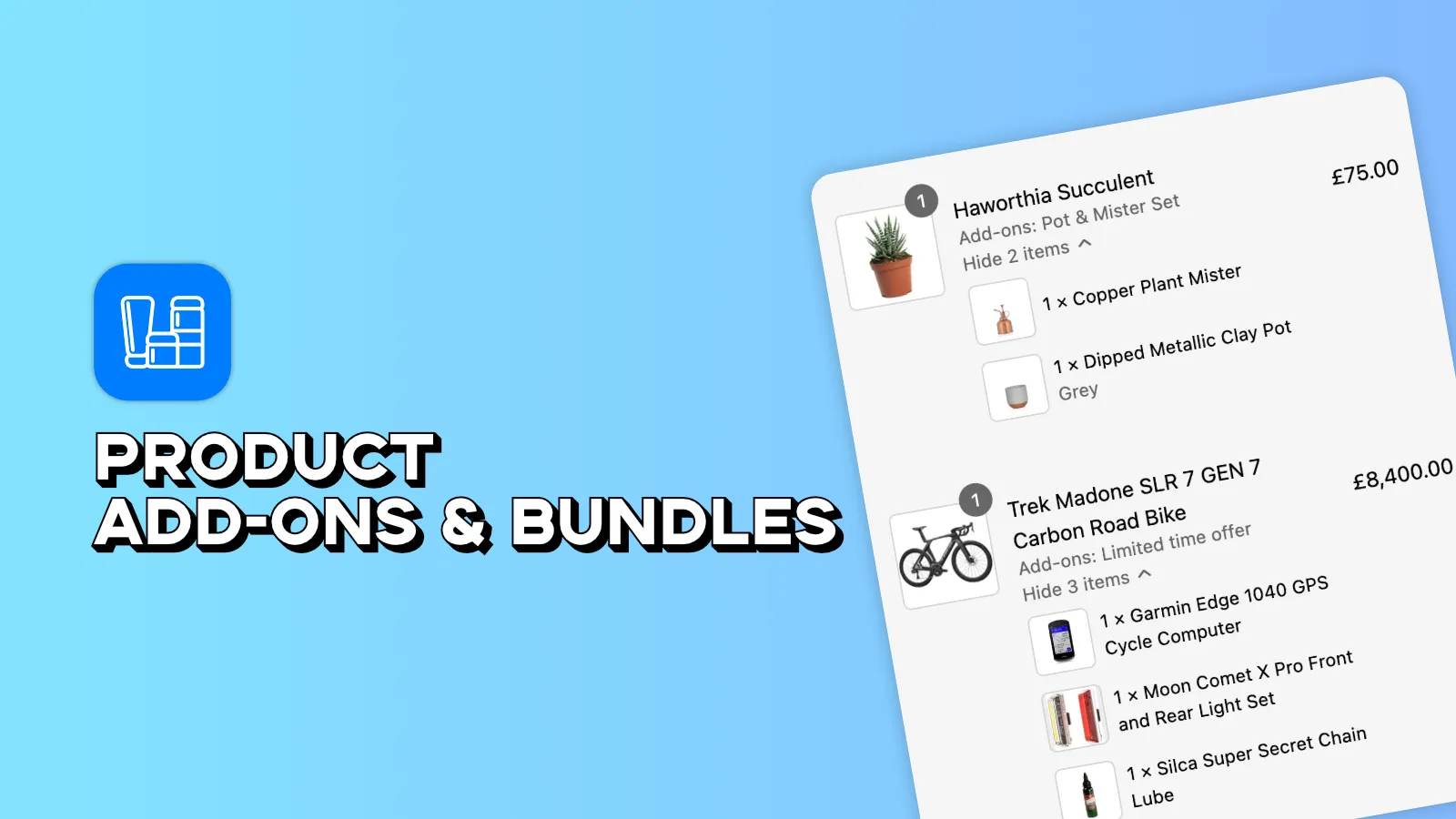
Both are covered properly elsewhere — bundles and add-ons that raise AOV for the mechanics, and where to put the block for placement. The short version:
- Add-ons should be small relative to the base price, obviously relevant, genuinely optional and charged as real line items. Two or three, not eight.
- Bundles need the inventory question answered before the offer is designed: own stock, or decrement the components. Getting this wrong produces oversells, which cost more than the bundle earned.
- Neither should ever be pre-ticked. Beyond being a dark pattern, pre-selected additional payments break UK and EU consumer protection rules.
Measuring it without fooling yourself
This is where most AOV work goes wrong. The changes are easy; the evaluation is not, and a wrong conclusion here compounds because it drives the next decision too.
- Watch conversion rate alongside AOV, always. A change that lifts AOV 8% while dropping conversion 10% is a loss wearing a win's clothing, and looking at AOV alone will never show it.
- Use revenue per session as the deciding number. It combines both, and it is the figure that actually pays for things.
- Give it two full weeks minimum, and enough orders to mean something. Most AOV experiments are killed or celebrated on sample sizes that support neither conclusion.
- Do not run it over a sale, a bank holiday or a payday week and compare to a normal one. Seasonality will beat your change in size every time.
- Change one thing. A threshold and an add-on block launched the same day cannot be told apart afterwards.
- Check the median as well as the mean. One £4,000 trade order will move a mean AOV and tell you nothing about what typical shoppers did.
What not to do
- Do not add offers to a page that is already slow. An upsell widget that costs you a second of load time is buying AOV with conversion rate, and the exchange rate is bad.
- Do not manufacture urgency to push the extras. A fake deadline on an add-on is the same regulatory risk as a fake sale, for a much smaller prize.
- Do not stack three apps that each add a widget near the buy button. The combined script weight and the visual clutter both cost more than any one of them returns.
- Do not raise the free shipping threshold repeatedly without watching conversion. There is a point where the puzzle stops feeling solvable and shoppers just leave.
Frequently asked questions
What is a good average order value for a Shopify store?
There is no useful benchmark, because AOV is a function of what you sell — a candle store and a furniture store have nothing to compare. The only meaningful comparison is your own store over time, and even then revenue per session is the better number, since it accounts for conversion rate moving in the opposite direction.
Where should I set my free shipping threshold?
Around 15–25% above your current average order value, and above your actual postage cost. Below your AOV and you are giving shipping away on orders that would have happened anyway. Show progress toward it in the cart, or the threshold does no work.
Do upsell pop-ups hurt conversion rate?
They can, and the damage is easy to miss because AOV goes up at the same time. Anything that interrupts the path to checkout needs watching on both numbers — use revenue per session to decide, since it is the one figure that combines them.
How long should I run an AOV test?
Two full weeks minimum, and long enough to accumulate a meaningful number of orders. Avoid comparing a promotional or holiday period against a normal one, and change one thing at a time — two changes launched together cannot be separated afterwards.
Is it better to raise AOV or conversion rate?
AOV is usually cheaper to move, because it needs no additional traffic and the changes are contained to pages you already control. But they trade against each other constantly, which is why revenue per session is the number to optimise rather than either one alone.
Start with the add-ons
Relevant add-ons on the product page, charged as real line items with stock tracked — the lowest-risk AOV lever there is. Free plan available, Pro at $7.99/month.
Shopify product bundles and add-ons that raise AOV
Bundle, add-on, upsell and cross-sell are four different mechanics. Using the wrong one is why most AOV experiments do nothing.
How to add product add-ons to a Shopify product page
Placement and relevance do the work here. An add-on below the fold, or one nobody wants, is just weight on your product page.
The best Shopify add-on and bundle apps, compared
This category mixes three different products under one label. Working out which one you need matters more than which vendor you pick.